
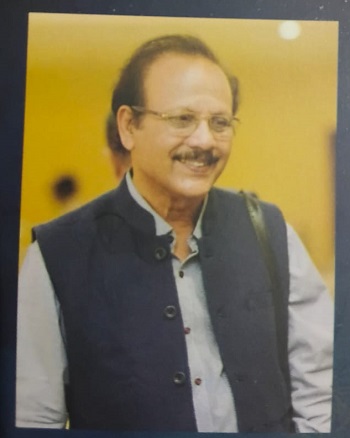
Q. 1. Recently, you have been awarded the prestigious Bharatiya Bhasha Parishad honour. How do you feel?
Ans. I feel deeply honoured and grateful to receive the Bharatiya Bhasha Parishad Award. For me, this recognition is not only personal; it is also a recognition of Assamese literature and culture. I owe this achievement to my readers, fellow writers, and all those who have supported my literary journey. I accept it on behalf of the entire Assamese literary community. Receiving this honour has renewed my sense of responsibility to continue contributing to our literature.
Q. 2. Please tell us in detail about this prestigious award, which has been conferred upon you for your lifelong contribution to Assamese literature.
Ans. The Bharatiya Bhasha Parishad Award is one of the most respected literary honours in India, especially in the field of Indian languages and regional literature. Established in 1975 in Kolkata, the Parishad has worked for the promotion of India’s multilingual literary culture not only through literary projects and publications, but also by presenting prestigious literary awards to authors writing in Indian languages, including the Kartritva Samagra Samman for lifetime achievement and the Yuva Puraskar for young writers. These awards strengthen the emotional and cultural unity of the country through literature.
Receiving the Kartritva Samagra Samman for my lifetime contribution to Assamese literature is, therefore, not merely a personal achievement, but also a recognition of the rich literary heritage of Assam and the enduring strength of the Assamese language itself.
Q. 3. Has this award affected your vision of literature? If so, how?
Ans. Receiving the Kartritva Samagra Samman Award from the Bharatiya Bhasha Parishad has certainly deepened and reaffirmed my vision of literature. It affirmed my vernacular identity — a writer’s choice to write in one’s mother tongue. It also encouraged me to delve deeper into our specific cultural landscape.
In the initial phase of my literary journey, my vision was rooted in social transition and geopolitical realities. Human empathy and sacrifice found a place amidst distressing situations, and I attempted to generate compassion through my writings. Recognition from a national-level institution has shifted my perspective from a localised audience to a pan-Indian readership, as such a multilingual institution bridges the gap between regional realities and a broader audience. It has elevated the author’s purpose from simple storytelling to the creation of a long-term cultural archive.
Apart from that, the award from the Parishad has also made me realise that, considering the global crises we face today, writers must cultivate perspectives that enhance empathy in the minds of readers and plant the seeds of humanity that may eventually pave the way for global peace.
Q. 4. You are known for the versatility of themes in your creations. What is your own opinion?
Ans. In the process of becoming a writer, I never realised that I had chosen such versatile themes for my creations. Your question has led me into a state of introspection.
Creativity, to me, is a mysterious process. It is mysterious because I never fully understand how a creative impulse germinates, lies dormant for years, and finally manifests itself in written form. Through introspection, I have been able to recollect some of those formative influences.
When I was nine years old, in 1957, our family moved from a mofussil town to our ancestral village after my father’s retirement. Our lands were cultivated by a few men, one of whom was Devenda — I still feel proud to recollect his name. After a day’s labour, he would bathe in the nearby Kolong River and, in the evening, come to our house carrying his dotara. Sitting in one corner of our courtyard, he would sing folk songs from erstwhile East Bengal.
One of his favourite songs was:
“Guru mure, upay bolo na,
Chiro dukhi janam dukhi, ami ekjona…”
(“Oh Master, show me the way; I am forever sorrowful and unhappy…”)
The devotion with which Devenda sang those songs made me understand their emotional depth even at that tender age. My mother’s affection for him — she would often cook food for him as a gesture of kindness — deepened my attachment to him and his music.
But after a year, he suddenly disappeared from the village. Some people said that he had been picked up by the police and pushed back to East Pakistan. His sudden disappearance saddened me deeply, yet his melodies remained alive within me.
Nearly twenty-five years later, while travelling through the Cachar district of Assam on my way to Aizawl, Mizoram, I witnessed the plight of displaced people from East Pakistan and Bangladesh. Those scenes revived Devenda’s melodies in my inner world. I felt the helplessness and grief of those people and experienced a strong urge to write about them.
It took another five years before I finally penned Upatyakar Pora Upatykaloi (available in English as From Valley to Valley since 2010 and in Bengali as Sthanantor since 2007). The novel depicts the background of Partition and migration, the horrors of communal clashes, the suffering of refugees in camps, the complexities of rehabilitation, and, amidst all this, the humanity that some individuals managed to preserve. Throughout the writing process, Devenda’s virtual presence never vanished from my mind. He still appears and disappears within me.
Similarly, two major incidents inspired me to write about the Mizo people and the society of Mizoram, where I served in a college for many years.
In 1976, while walking to college through a village, I noticed a handwritten note attached to a bamboo post. A student walking beside me explained that the owner of the house had written:
“Someone’s hen has laid two eggs in our house. If nobody claims them within three days, we shall eat them.”
At first, it seemed humorous, but ultimately it struck me as a monumental expression of honesty and simplicity. Later, I understood that the Mizo society is deeply rooted in the concept of Tlawmngaihna — the spirit of considering and acting from another person’s point of view.
I also witnessed an extraordinary political gesture: an elected Chief Minister stepping down and inviting a rebel leader to assume office in order to restore peace after twenty years of insurgency. Such sacrifice and statesmanship are rare anywhere in the world.
These experiences prompted me to write Diktawn (available in English as The Highlanders since 2018) to dispel misconceptions about the people of Mizoram.
Through introspection, I now realise that many such experiences planted the seeds of creativity within me — inspiring me to chronicle linguistic and cultural shifts, structural social changes, heritage and civilisation, friendship between Gandhi and Tolstoy, non-violence, and many other themes.
Yes, your question has made me realise that my creative world is indeed versatile, spanning socio-historical narratives, geographic and cultural explorations, and complex human relationships.
Q. 5. Your vision of life seems to be varied. How did you cultivate this perspective?
Ans. My perspective on life evolved as I lived among different people in different places and at different times.
As a young graduate of twenty, when I moved from my hometown Nagaon to Dibrugarh University in 1968 to pursue my M.Sc., I was deeply impressed by the bright and dynamic young teachers there. After completing my M.Sc. with distinction, I joined as a UGC research scholar, fulfilling the expectations of my teachers and well-wishers.
Yet something within me remained unsettled. Driven by a longing for a different experience, I moved first to Kohima, where I joined Kohima Science College and worked for three years. Later, I moved to Aizawl and joined Pachhunga University College, where I served for thirty-seven years.
Living and working in the hills helped me develop a broader and more reflective vision of life, society, and humanity. I came to understand the humanism and cultural richness of the tribal communities among whom I lived. As a writer, I felt morally responsible for portraying their lives with honesty and empathy, which eventually led me to write my first novel on Mizo society.
Gradually, through my writings on displaced people and marginalised communities, I developed an ongoing dialogue between the individual and humanity. Over time, this process became a journey of inner awakening in which memories, emotions, history, and social experiences intertwined.
Later, my vision of life evolved further into one of ethical awareness and spiritual reflection. In such a vision, class, region, and ideology merge into a synthesis of creativity, humanity, cultural rootedness, and universal compassion.
Q. 6. Your communication style is very attractive. How would you interpret it?
Ans. As far as my communicative style is concerned, it is for critics like you, rather than for me, to comment upon it.
Once, a non-Assamese friend of mine, who was a voracious reader of Assamese fiction, asked why he could read Upatyakar Pora Upatykaloi effortlessly, but struggled with Kolong Paror Itikotha. I explained that the first novel was set between the 1950s and the 1980s, whereas the second belonged to the social milieu of the 1930s to the 1950s. The timeline and societal background naturally shaped the language and style of each work.
One aspect I can mention, however, is that a thorough understanding of the theme allows my characters to speak within my imaginative world in a manner that perhaps blends emotional warmth with cultural rootedness. It is not merely the elegance of language that matters, but also the ability to connect the author’s feelings with those of the readers.
These feelings flow like an undercurrent of compassion, dignity, and respect for humanity, inviting readers into reflection. Perhaps that is the root of whatever attractiveness my fiction may possess.
Q. 7. You have been honoured in Assam for one of your novels. Please tell us about it in detail.
Ans. I have been honoured twice in Assam — first by the Asam Sahitya Sabha, which conferred upon me the Sabhapotir Visista Sahitya Sanman for 2022–23 in recognition of my overall contribution to Assamese literature, and secondly by the Publication Board of Assam, which awarded me the Axom Prakashan Parishad Sahitya Bota for 2025 for my novel Aishwarya.
Perhaps you are referring to the second award. The novel is set in the latter part of the twelfth century. Its protagonist, a young Jain monk named Rishavnath, is compelled to leave the caves of Udayagiri and Khandagiri due to distressing circumstances. He wanders across Central India for twelve years, travelling through Nalanda, Pataliputra, Varanasi, Ujjain, Shravanabelagola, and Puri before eventually returning to Udayagiri and Khandagiri.
Through his journey, I attempted to explore the religious and cultural heritage that we have inherited from our ancestors. I am delighted that Aishwarya was selected for the Assam Publication Board Literary Award for 2025.
Q. 8. How do you connect life with literature?
Ans. Literature is not detached imagination; it is an artistic reflection of lived experience, memory, emotion, society, and moral consciousness.
When I introspect upon my own literary journey, I can clearly see this connection. As a nine-year-old boy, I listened to Devenda’s melancholic folk songs, and as a thirty-year-old man, I witnessed the suffering of displaced people in the Cachar district. Those experiences eventually manifested in the novel Upatyakar Pora Upatykaloi, which depicts the lives, struggles, and agony of people displaced by Partition and migration.
Similarly, the honesty and simplicity I encountered in Mizoram inspired Diktawn (The Highlanders). The trust among ordinary villagers, their collective spirit, and the sacrifices made for peace deeply moved me. Through the novel, I sought to portray the struggles, aspirations, social transformations, and cultural identity of the Mizo people while preserving individual sensitivity.
The connection between life and literature is ultimately shaped through empathy. While writing a short novel on surrogacy — about an American couple travelling to Delhi to have a child through a surrogate mother — I found myself reflecting upon the ancient migrations of humanity and the interconnectedness of all human beings. In the fictional narrative, the crying of the child in America simultaneously evokes the sorrow of the surrogate mother’s own children in Delhi. Such scenes were created to awaken empathy and humanity in readers.
Other works of mine — such as Kolong Paror Itikotha, Aishwarya, and Mahanagaror Najon Nibashi — are similarly rooted in lived experiences, history, social realities, and moral reflection.
Therefore, my literary vision is deeply grounded in the belief that literature is inseparable from life. I have always regarded the novel as a living archive of socio-political history and human resilience.
Q. 9. Your writing belongs to the serious genre of literature. What would you say about it?
Ans. Throughout literary history, fiction has remained one of the most serious forms of human expression. It serves as a vital mirror to the human condition by offering philosophical, psychological, and social insights.
Fiction explores the complexities of life, interprets human emotions, questions social structures, and preserves the folk history and culture of civilisation. Its seriousness lies in its ability to penetrate the inner life of human beings. Through imaginary worlds and invented characters, fiction often reveals truths that factual writing alone cannot fully capture.
Many social and administrative transformations throughout history have been influenced by fiction. The Grapes of Wrath by John Steinbeck is one such example. The novel’s portrayal of migrant workers’ suffering and the greed of corporate farming interests made it both a powerful force for social reform and a subject of intense controversy. After its publication in 1939, it triggered significant social, political, and economic reactions in the United States.
Likewise, serious readers may find in my fictional narratives many such themes and questions worthy of reflection. Therefore, the fictional form I have chosen as a medium of expression is not only serious, but profoundly important as well.
Q. 10. Finally, how would you place yourself within the domain of Assamese fiction in relation to your indigenous response?
Ans. Assamese fiction has historically passed through several phases — from romantic humanistic narratives to psychological realism and the socio-political consciousness of later writers. Within this continuum, it is difficult for me to place myself; perhaps others are better suited to make that assessment.
However, through my narratives, I have attempted to synthesise literary sensitivity with indigenous rootedness. My fictional world does not merely narrate stories; it responds to the cultural anxieties, social transformations, and existential struggles of Assamese society. It reflects the rhythms of rural life — villages, rivers, folk traditions, oral memories, changing moral structures, and the emotional conflicts of ordinary people — while also giving voice to marginalised emotions and silent suffering.
My narratives have addressed both national themes, as in Aishwarya, and global themes, as in Mahanagaror Najon Nibashi. I have often realised that rivers may differ in name but remain fundamentally the same; villages may differ in environment and customs, yet human emotions, aspirations, and social transformations remain universal.
This literary journey has been a profoundly enriching experience — one that is impossible to forget. Perhaps such experimentation is relatively rare within Assamese fiction.
Under such circumstances, may I be regarded as a culturally rooted humanistic storyteller?
About the author
Deepak Kumar Borkakoti is a distinguished Assamese novelist, storyteller, and literary thinker whose works reflect deep humanism, cultural rootedness, and socio-historical consciousness. Widely respected for his versatile themes and profound narrative style, he has made significant contributions to Assamese literature through novels that explore migration, displacement, social transformation, indigenous identity, and universal humanity.
Having lived and worked for many years in the Northeastern hills, particularly in Mizoram, Borkakoti developed a rare literary vision shaped by diverse cultures, lived experiences, and human relationships. His acclaimed novels, including Upatyakar Pora Upatykaloi (From Valley to Valley), Diktawn (The Highlanders), Kolong Paror Itikotha, Aishwarya, and Mahanagaror Najon Nibashi, are recognised for their emotional depth, historical insight, and empathetic portrayal of ordinary lives.
A recipient of the prestigious Bharatiya Bhasha Parishad’s Kartritva Samagra Samman for his lifelong contribution to Assamese literature, Borkakoti has also been honoured by the Asam Sahitya Sabha and the Publication Board of Assam. His literary works serve not merely as fictional narratives, but as living archives of cultural memory, social change, and human resilience.


