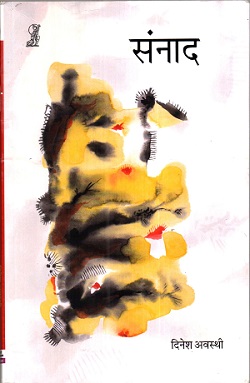
Book Review written by Subhajit Bhadra
“Awasthi’s stories meditate on life, death, love, hatred, compassion, and nature, but what triumphs is a profound sense of humanism.”
“His stories are like the iceberg theory of Hemingway—economical, precise, and deeply human.”
Hindi literature occupies a unique position in the Indian literary landscape. Unlike Bengali, Assamese, or Odia literatures, which often remain tied to specific regions, Hindi literature stretches across a vast geographical and cultural expanse. This breadth has freed Hindi writers from provincial limitations, allowing them to explore diverse themes and voices. Within this tradition, Dinesh Awasthi’s Sannad emerges as a significant contribution—a collection of twenty-four short stories that combine philosophical depth, stylistic experimentation, and a profound humanism.
Buy Sannad by Dinesh AwasthiAwasthi’s craft recalls Hemingway’s “iceberg theory,” where meaning lies beneath the surface and every word is deliberate. His prose is economical yet evocative, never indulging in unnecessary ornamentation. The stories meditate on universal themes—life, death, love, hatred, compassion, grievance, and nature—but what ultimately triumphs is a deep sense of humanism. Short, pithy, and crisp, they embody the true essence of the short story form. In their descriptive exploration of human existence, Awasthi’s work invites comparison with Priyamvad and Nirmal Verma, two stalwarts of Hindi modernism.
“Awasthi’s stories meditate on life, death, love, hatred, compassion, and nature, but what triumphs is a profound sense of humanism.”
Key Stories and Themes
“Punishment can never be complete because crime is never complete.”
Purna Dand begins with the daily routine of an old professor, solitary and self-critical, who punishes himself by dwelling on his deficiencies. His reflections on death and astronomy are interwoven with philosophical musings on punishment. Awasthi’s striking assertion—“punishment can never be complete because crime is never complete”—introduces a fresh perspective into Hindi fiction. The character’s solitude and disconnection from society highlight the existential undertones of the story.
Shobnom Mosi presents the first queer MLA in Madhya Pradesh, a strong and assertive figure whose philanthropy contrasts with her irritation at the narrator’s Brahmin identity. The story’s digressions into atomic bombs and their destructive potential underscore Mosi’s humane nature, making her both a political and moral presence.
Adhura Syllabus explores art and artistry, beginning abruptly and unfolding into a postmodern narrative. One character promises to create a “syllabus of grief,” and the story’s open-endedness recalls the intellectual resonance of Nirmal Verma, Vinod Kumar Shukla, and even Milan Kundera. Its unfinished quality mirrors the incompleteness of human relationships, as Shekharjee and Pushpajee’s unspoken love lingers unresolved.
Dent stages a dialogue between a sage and his pupil, weaving together philosophy, poetry, disease, nanotechnology, and quantum physics. The intertextual references to Muktibodh’s poetry and Julia Kristeva’s concept of “intertextuality” enrich the narrative, while the blend of seriousness and humor exemplifies Awasthi’s style.
Kuch Unse Puchhe, Jinhe Zindagi Ne Mara satirizes Indian bureaucracy and exposes the hypocrisy of fake sages. With mythological references to the Ramayana and Angad, the story resists closure, embodying postmodern narrative techniques.
Other stories expand the thematic range:
- Dombh explores the tension between pride and melancholy.
- Karwi Muskan portrays a woman’s uncompromising commitment to truth, layered with romantic subtext.
- Underlines uses the metaphor of “underline” to weave together disease, death, writer’s block, dissent, and love, creating a multilayered narrative.
- Self Goal narrates Raghunath’s tumultuous life as a henpecked husband, revealing the paradox of grief after his wife’s death.
- Balla depicts a terrifying figure whose appearance alone unsettles children, offering a rare plot-driven story in Awasthi’s oeuvre.
“In Sannad, one finds a new genre—‘essayistic short stories’—where description triumphs over dialogue.”
Contribution to Hindi Literature
What distinguishes Sannad is Awasthi’s experimentation with form. Many of his stories can be described as “essayistic short stories,” where description often outweighs dialogue. Yet sensitivity and compassion permeate every narrative. His voice is authentic, experimental, and deeply humane, appealing to serious readers of literature. By blending philosophical reflection with narrative economy, Awasthi leaves a lasting mark on contemporary Hindi literature.
Buy Sannad by Dinesh AwasthiAbout the author
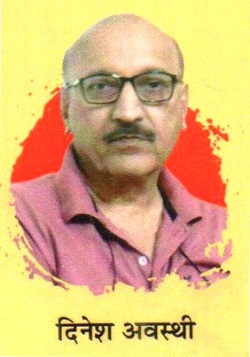 Dinesh Awasthi is a writer, poet, critic based in Jabalpur, Madhya Pradesh. Professionally he has been associated with education. He is the Director with State Institute of Science Education and College of Teacher Education, Jabalpur, Madhya Pradesh. He is an avid reader and has fascination for music and movies along with theatre.