Chapter 18: The Power in Partnerships – and the Problems
I had by now met a good number of police personnel and realised that I had been prejudiced. I’d learnt that the entire department wasn’t corrupt; on the contrary, some of them were great human beings. The rest were either apathetic or demotivated, although of course some were just truly bad apples. We needed to move the ones in the middle, the fence-sitters, engage with them and sensitise them. If we told them the actual stories of women and children, I hoped they would sympathise and respond appropriately.
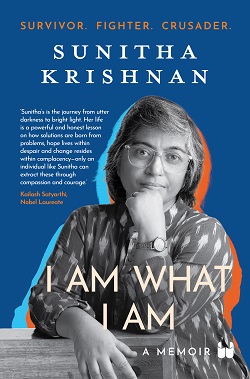
This is an excerpt from I Am What I Am: A Memoir’ written by Sunitha Krishnan.
When I proposed this to Prasad Rao, then police commissioner of Hyderabad, he organised such a session within two days of my visit. It was here that I first met A.K. Khan and Mahesh Muralidhar Bhagwat, IPS officers who would play a great role in Prajwala’s work in the coming years. Bhagwat is the most dynamic police officer that I have ever met. His commitment to end sex trafficking stayed strong all through his tenure. Of all the police officers I’ve met, he has the most sound understanding of the role of the police force in prevention, protection and prosecution. He leveraged every existing law to fight the problem, something he continues to do.
~ An Activist’s Powerful Memoir Exposing the Systems Behind Sex Trafficking and the Fight to Dismantle Them ~
With Khan’s help, we established counselling facilities within police stations, where women in prostitution were advised on other ways to make a living. We set up these facilities at police stations in Tank Bund, Necklace Road, Gopalapuram and Afzalgunj. This was a first-of-its-kind venture, and showed a different face of policing to the public.
Partnering with the police department helped us rescue thousands of women and girls from different parts of the country. But every relationship has its difficulties. The police system is especially hierarchical, so junior officers hesitate to take initiative, preferring to follow their seniors’ orders. If the superior officer was disinclined to work with us, any expectation of cooperation from the junior rungs was doomed right away.
Some of it has been my fault. My abrasive tongue has riled many people. On one occasion, a senior police officer called me to his room and accused me of getting too big for my boots, threatening me with non-cooperation from his entire team. Apparently, someone within the department had told him that I had criticised the Hyderabad police in Kerala. Frankly, I can’t rule out that possibility—I most likely did so not only in Kerala but elsewhere as well. But I’d have done it in the context of a case, and if they had heard the whole speech, they would have realised that I also highlight the good work.
Some of it has been due to people’s insecurities—the fear that I would hijack their efforts and walk away with the credit. I speak with a certain authority, and I don’t beat about the bush. I know my work and I can back up claims with facts. My confidence is hard to digest for some, which means I’m often painted as anti-establishment, and both Prajwala and I are sidelined. For instance, Prajwala, which has earned a reputation in the anti-trafficking sphere even internationally, once failed to receive an invite to a national anti-trafficking conference organised by police in Hyderabad. This just goes to show that police officers are as susceptible to frailties as the rest of us.
~ Featured Among Newsweek’s List of 150 ‘Fearless Women in the World’ ~
Despite the bad eggs in the system and some self-sabotaging on my part, Prajwala has assisted in the removal of over 28,600 women and girls from commercial sexual exploitation in the last twenty-seven years, and the entire credit goes to the police department. Left to my own devices, I might have rescued a couple more people before getting murdered and tossed somewhere in broad daylight, much like Akbar Bhai.
Such positive experiences—the teamwork, the concerted efforts—are what have shifted my language from an egocentric ‘I’ to a collaborative ‘we’. The power of partnership is immense, and just as the police are crucial to rescue efforts, organisations like Prajwala play a critical role in victim protection and supporting the prosecution of criminals.
We used the insights we gained from years of practical experience, studied existing legal frameworks and created manuals that codify victim-centric investigations in partnership with legal experts. Prajwala’s manuals and handbooks are considered the most practical tools in sensitising personnel, and have been used in training thousands of police officers. Victims thus receive not only protection, but also humane and sensitive treatment from responding officers and others, thus greatly increasing their chances of cooperating with the police to help prosecute the culprits. That’s what makes a victim-centric approach a win-win for law enforcement and the victims themselves.
Our partnership with the Women Development and Child Welfare department started much earlier, when they provided space to open pizza parlours operated by trafficking survivors. Since then, Prajwala has worked closely with the department to build community vigilance, train anganwadi workers on responding to human trafficking cases, improve the conditions of government-supported homes like Swadhar and Ujjwala and co-manage government shelters for trafficked victims.
About the author

Sunitha Krishnan is an activist, author and film producer. She has founded Prajwala – Asia’s largest institution combating sex trafficking and sex crime. Since its inception in 1996 at Hyderabad, Sunitha has assisted in the rescue of more than 31,200 young girls and women across 12 countries from sex slavery and has prevented 17,000 children from being inducted into prostitution.
Recipient of the fourth highest Indian Civilian Honor- Padma Shri, and recognized as 150 “Fearless Women in the World’ by Newsweek, Sunitha envisions a world free of sex trafficking and sex crime and has galvanised her vision by confronting traffickers, supporting survivors and developing innovative models of prevention to disrupt the cycle of inter-generational exploitation.
Sunitha Krishnan’s memoir “I Am What I Am” released a year back is now being translated in multiple Indian languages and is considered as one of the most compelling memoir of an activist. She is also the producer of multiple award winning feature films “Naa Bangaaru Talli” on sex trafficking and “Dahini The Witch” on witch-hunting.