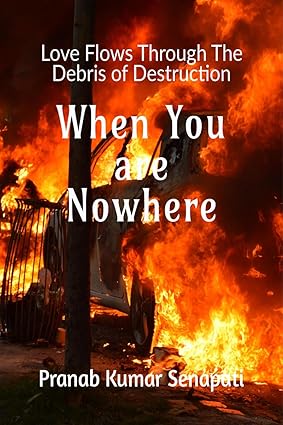
Some books don’t announce themselves loudly. They don’t arrive with dramatic twists or grand declarations. Instead, they sit quietly beside you, slowly opening emotional doors you didn’t know existed. When You Are Nowhere: Love Flows Through the Debris of Destruction is one such book—a tender, haunting exploration of love, loss, displacement, and the fragile hope that survives even when everything else collapses.
At its heart, this book is about being lost—not just geographically, but emotionally and spiritually. It speaks to those moments in life when certainty disappears, when familiar structures crumble, and when the idea of “home” feels distant or even imaginary. The narrative flows through destruction, but it never lingers there aimlessly. Instead, it searches for something enduring: love in its quietest, most resilient form.
Love in the Aftermath
Unlike conventional love stories that bloom in comfort, When You Are Nowhere places love amid chaos. The story suggests that love does not require perfection to exist—it often grows strongest in broken spaces. Through vivid imagery and emotionally grounded storytelling, the book shows how human connection becomes a lifeline when everything else feels unstable.
The characters don’t chase idealized romance. Their love is hesitant, scarred, and deeply human. It’s the kind of love that learns to survive without promises, thriving instead on presence, understanding, and shared silence. This portrayal feels authentic, especially in a world where many readers are navigating uncertainty, grief, and emotional fatigue.
The Weight of Displacement
A powerful theme running through the book is displacement—physical, emotional, and psychological. The feeling of being “nowhere” is not just a setting; it’s a state of mind. The characters exist between what was and what might never be again. Through them, the book asks difficult questions: What happens when the past no longer feels safe? How do you rebuild an identity when the foundations are gone?
Rather than offering easy answers, the narrative allows readers to sit with discomfort. It acknowledges that healing is rarely linear and that survival itself can be an act of quiet rebellion. This honesty is what makes the book deeply moving. It doesn’t rush toward hope—it earns it.
Language That Lingers
One of the book’s greatest strengths lies in its prose. The writing is restrained yet evocative, allowing emotion to seep through without excess. Moments of tenderness are understated but powerful, making them linger long after the page is turned. Destruction is not sensationalized; instead, it is rendered with a sense of reverence for what was lost.
The metaphor of debris is particularly striking. It represents not only physical ruin but emotional remnants—memories, regrets, unfinished conversations. And yet, love moves through this debris gently, finding space where none seems possible.
Why This Book Resonates Now
In a time marked by global uncertainty, personal upheavals, and emotional exhaustion, When You Are Nowhere feels especially relevant. It speaks to readers who feel untethered, who are learning to live with unanswered questions. The book doesn’t promise transformation overnight, but it offers something more valuable: recognition.
Readers who appreciate introspective fiction, emotional realism, and stories that prioritize inner journeys over external spectacle will find this book deeply rewarding. It’s not about grand victories—it’s about endurance, connection, and the quiet courage to keep feeling even when it hurts.
A Story That Stays With You
This is not a book you rush through. It asks for patience, reflection, and emotional openness. And in return, it gives readers something rare—a sense of companionship in loneliness. By the time you reach the final pages, you realize that “nowhere” is not an absence, but a space where love learns new shapes.
If you enjoy fiction that explores human vulnerability with sensitivity and depth, When You Are Nowhere: Love Flows Through the Debris of Destruction deserves a place on your shelf.
Read more articles on- Authors and Books