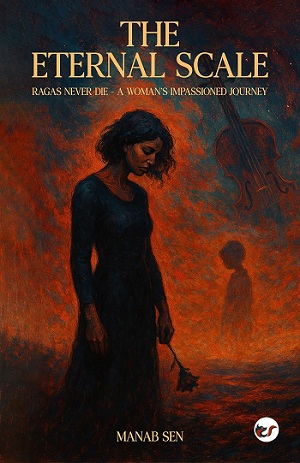
In a world that runs on speed, notifications, and trends that change every sunrise, there exists a kind of art that refuses to be hurried. Indian classical music has always been that quiet rebel—timeless, patient, and soul-stirring. THE ETERNAL SCALE: Ragas Never Die takes this timelessness and weaves it into the life of a woman whose story is as emotionally complex as the ragas she devotes herself to. What emerges is a narrative that is tender, fierce, and profoundly human.
The novel begins with a gentle, almost meditative rhythm. We meet the protagonist as a young girl who instinctively responds to sound. Music isn’t taught to her at first—it arrives naturally, like a monsoon breeze. Her first connection to ragas is not technical; it’s emotional. The notes comfort her, challenge her, surprise her. But as she grows, so does the pressure of the world around her. Expectations tighten like invisible strings, and suddenly, music becomes something she has to fight for instead of something that freely flows.
🎵 Feel the Soul of Every Raga – Tap to Begin the Journey!
Step into a world where music heals, empowers, and awakens the spirit. Click below to explore The Eternal Scale – a story that stays with you like a haunting melody.
Her journey mirrors the structure of a classical performance. The early chapters feel like an alap—slow, searching, spacious. The author allows us to linger on her inner world as she discovers that her dreams don’t align neatly with society’s expectations. The world she inhabits is loving but rigid, and like many young women, the protagonist learns early that passion often demands courage she’s not sure she has.
Yet she keeps returning to the ragas that shaped her childhood. They become her refuge, her protest, her whispered declaration of selfhood. As she moves into adulthood, the emotional intensity deepens. The narrative begins to take on rhythmic clarity—like the jor in a performance—bringing structure, conflict, and a rising tempo. This is where the book shines the brightest.
The author doesn’t simply tell us her life events; they let us feel them through music. Each raga becomes a metaphor for her personal battles. Raag Bhairav becomes the raga of her early morning doubts. Raag Yaman carries the soft ache of longing. Raag Todi echoes her loneliness during moments when the world seems overwhelming. And Raag Desh bursts into her story like a celebration, reminding her (and us) that hope is always waiting to return.
One of the most compelling aspects of the book is the emotional realism. The protagonist isn’t painted as a flawless musical prodigy. She falters. She breaks. She questions herself. There are moments where she considers giving up entirely. Her world is filled with cultural expectations, gendered limitations, and the subtle weight of being “acceptable.” The writing here is sharp and empathetic—it holds space for her pain without drowning in it.
Then comes the turning point. Not a dramatic explosion, but a quiet moment of self-recognition. She realises that music is not something she does; it is something she is. This revelation marks a shift in her journey—a kind of rhythmic acceleration, akin to the jhala where notes spin faster and the emotional stakes heighten. She trains harder, trusts herself more, and begins to step into her own voice instead of imitating the world’s idea of perfection.
The book beautifully portrays her relationship with her instrument. The tanpura becomes more than a background drone—it becomes her emotional backbone. There’s a lovely recurring image of her sitting in dim light, tuning the strings by instinct, feeling the vibrations like a living connection. These moments remind us that true art is intimate. It demands presence. It demands surrender.
Her eventual entry into the performance world is messy but exhilarating. She encounters criticism, dismissiveness, and competition—but also admiration, mentorship, and unexpected allies. The author captures the thrill and terror of standing before an audience, waiting to deliver the first note that will reveal everything she has become.
And then comes the performance that changes everything.
This climax is written with breathtaking sensitivity. As she begins to sing, she sheds years of doubt and silence. Her voice carries the weight of her past but also the promise of her future. Each note lands not as technical mastery but as emotional truth. The audience feels it. We feel it. And in that moment, she realises what the ragas had been trying to teach her all along:
Ragas never die. And neither does the strength of a woman who chooses to honour her voice.
What makes THE ETERNAL SCALE unforgettable is not just the musical insight, but the profound portrayal of identity. The story asks: What do we owe to ourselves? What happens when art becomes the language of survival? How does a woman reclaim her inner world when society tries to compose her life for her?
By the final pages, the book leaves us with a lingering emotion, like the soft resonance of a last note fading into silence. It’s hopeful, inspiring, and deeply reflective. And it gently reminds us that music—real music—doesn’t just entertain us. It shapes us, heals us, reveals us.
If you are someone who has ever been moved by a melody, or fought quietly for your dreams, or found solace in something only you understood—this book will feel like coming home.